

© M3TIN Records
The M3TIN
Manifesto
M3TIN — Songwriter & Music Architect
Available in 7 languages: English · Türkçe · Français · Español · Português (Brasil) · Русский · العربية
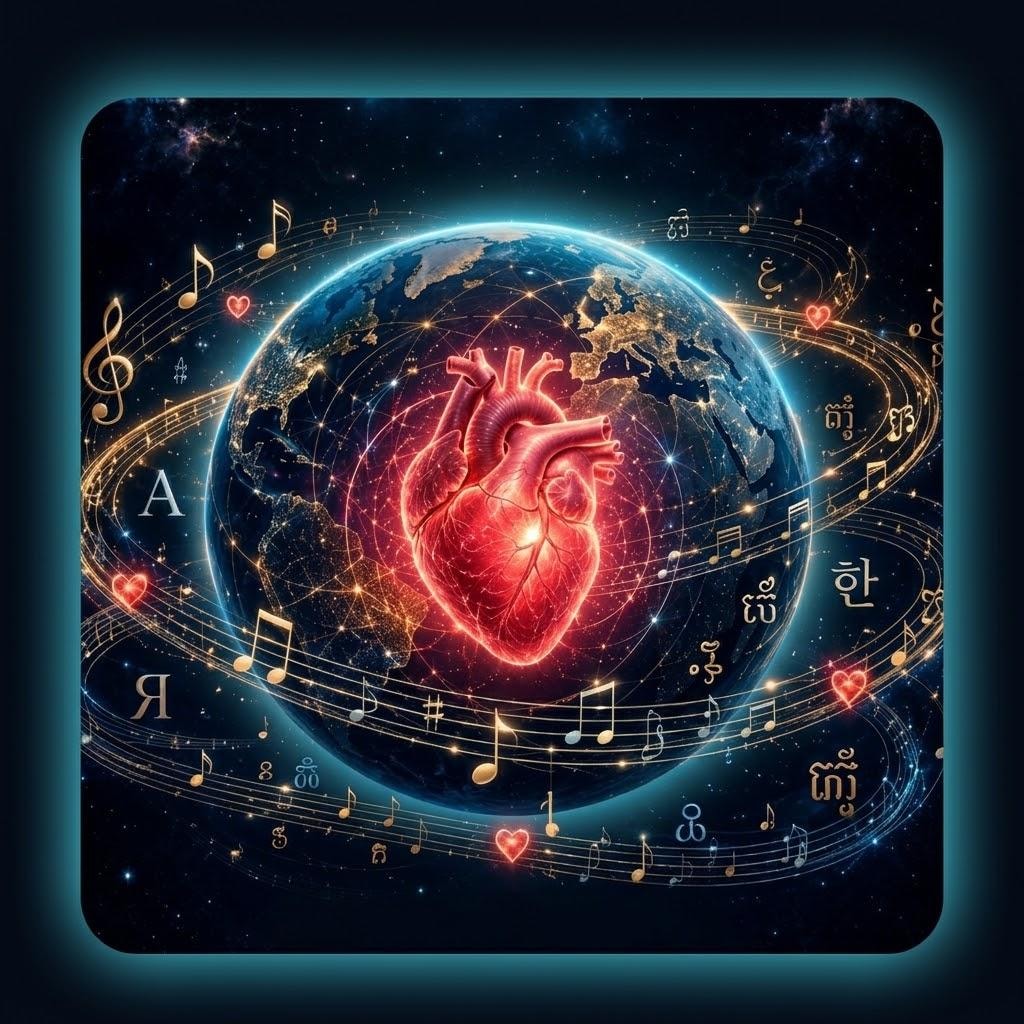
There are more than seven thousand languages on Earth.
Just twenty-three of them speak to more than half of humanity.
In our first year, our songs have come to life in eight of those twenty-three.
Every language sounds different. Every heart beats the same.
That is why this journey began — not to translate songs, but to prove something:
Languages divide the world; music is the one language the heart speaks.
We don’t press a button.
Anyone can generate a song today. We don’t generate — we give birth, in every language, one at a time. Every lyric is adapted native-first: local idioms, local imagery, every line signed off by a native speaker before a single note is released. A Khmer ballad breathes through the tro sau and roneat ek. A Kazakh anthem carries Kazakh strings. Same heart — a new body, every time.
The brush isn’t the painter. The tool isn’t the artist.
Michelangelo carved David from a block of marble other sculptors had rejected as flawed. Painter, sculptor, architect — five hundred years later, the world remembers what he made, not what he made it with. No one stands under the Sistine ceiling and asks which brush he used. Every new tool in history was called cheating first: photography was “not art,” the synthesizer was “not music,” and today AI is “not creation.” We use the instruments of our century, openly — we hide none of them. But no instrument chooses the language. No instrument asks a native speaker in Phnom Penh whether a line breaks the heart the right way. No instrument decides to save the homecoming for last. The heart behind the machine does. And let the record state it plainly: every lyric in this catalog is an original work — conceived, shaped, and owned by its author, Ahmet Metin Oktay — who leads the machines the way a conductor leads an orchestra. The orchestra plays. The author writes. So judge us the way the world judges Michelangelo: by the work — not by the chisel.
We don’t translate. We adapt — the way hearts adapt.
Every version of a song keeps everything that makes it that song: the same story, the same emotions, the same melodic heart. What changes is only how they are spoken — each language receives the story through its own idioms, its own imagery, its own way of saying goodbye. A line that breaks hearts in Turkish might merely inform in Khmer if carried word for word — so we never carry words. We carry the feeling, and find the line a Khmer heart would actually say at that moment; a native speaker confirms it before a single note is released. Not a translation. Not a different song. The same heartbreak — fluent in your language.
We sing the languages the world risks forgetting.
Nearly half of Earth’s languages are in danger of falling silent. So we don’t only sing in the languages of the many — we sing in Khmer, in Kazakh — in the languages the world risks forgetting. Because a heartbeat doesn’t check how many people share your mother tongue. And when a song lives in a language, that language lives a little longer.
We claim hearts, not polish.
We do not claim the best mixing or the best mastering. We claim the best adaptation — melodies that cross borders, emotions that marry regions. We claim that you don’t need millions of dollars to reach hearts. Our bet is simple: hearts buy in first, and polish follows. When these songs prove themselves, talented singers, musicians and producers will take them to the next level — because a song the heart has already accepted will always find better hands. The finest mix in the world cannot make a heart feel what isn’t there. We put it there first.
Songs used to need a passport. Ours sail without one.
Explorers once crossed oceans and called the lands they found “new” — forgetting that people already lived there. We cross oceans too. But we never forget: every shore we reach is already someone’s home, with its own songs, its own instruments, its own way of saying I miss you. We don’t arrive to plant a flag. We arrive to learn the language — and sing it back to the people who taught the world how it sounds.
We do homecoming last.
Every artist starts local and dreams of going global. We reversed the map. We started global — Kazakh, Khmer, Arabic, French, Portuguese, Spanish — and we are becoming local, everywhere, first. Home is not where we begin. Home is the finale.
One artist. Many voices.
Not a roster. Not features. Every title carries one name — one artist who writes, shapes and owns every song, and lends it whichever voice it needs: male, female, in eight languages and counting. The voices change. The name doesn’t. Because the point was never the voices or the languages. The point was always the heart.
Others will follow this route one day.
Good — we drew the map.